Saturday, December 3, 2011

Wyoming Dispatch: Devils Tower

Yesterday, we Jentel residents decided to take a road trip to Devils Tower. It's a two-hour drive from here, perfect for a day trip. As we were leaving, the sun was shining, rays catching the ice that had covered the trees, blinding us with a glittering display.
Devils Tower really is a surreal formation. As shown above, it rises out of nowhere. Jentel, I believe, has a higher elevation, so we passed from its blue-gray landscape into one of straw colored grass and rock formations thickly striated with red.


We arrived at the base, ate a chilly picnic lunch, and started walking the trail that circles the base of the Tower. As we walked, I realized we were going counter-clockwise from east to west, a circumnabulation much like a walking mediation. A repeated theme to our conversations was comparing the Tower to a human body part: a toe, a penis, a nipple (those last two were Dan). Despite our humor at this, I couldn't help but think that that such discussions were reflective of how we could see ourselves in this formation. Maybe it's just some form of egotistical humancentrification, but maybe it was also a reflection of how humans can see reflections in nature, and the potential therein.

The picture above doesn't communicate how many colors were in the rock, yellows, oranges, greens, pinks, all completely unexpected. As we navigated the trail, we came first to its sunny side, which offered a vista through the remains of a previous forest fire.

Proceeding, we made our way to the shady, cooler side of the Tower, where winter seemed much more evident. If this was a walking meditation, I thought, then we had descended from sun/life to a contemplation of winter/death/slumber.


We emerged back at the beginning of the circular trail. I had been continuing my thoughts on finding healing in the landscape, and even noticed a quote in the visitors' center about how certain Native Americans find renewal and rehabilitation in the Black Hills, just east of the Tower. (The Tower is also a sacred site to many of the original inhabitants of this area, and as we walked we saw the remains of offerings tied to trees).

Our good weather ran out as we neared home; we were hit with fog and snow but managed to make it back to Jentel safely. All my thoughts on healing fled that evening as I called Robert and found out he had a pretty painful day, returning me to worry, shame and confusion, and all my conflictions about being here in Wyoming. There is little over a week till I return, and whatever that might bring.

Thursday, December 1, 2011

Wyoming Dispatch: By Hand


I've been steadily working on a print that is going to take the form of a triptych - three blocks printed on three separate pieces of paper, one continuous image. Below, Blanche calendars the paper.


Each block has selective inking, so that in one round of printing I am printing two colors. The image is inspired by the wintery landscape and its colors here - a minimal palette, only shades of gray, blue, black.


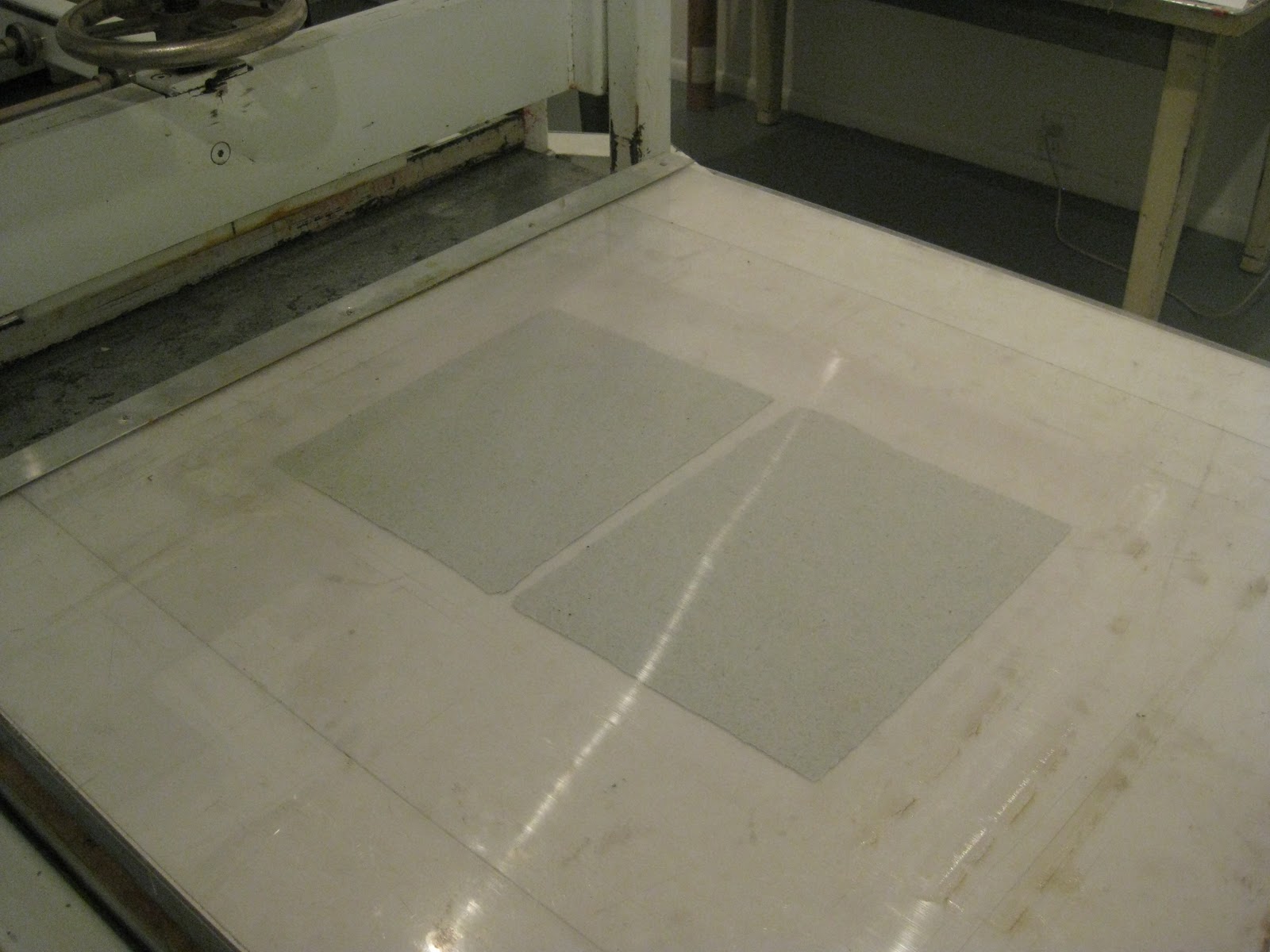
The block will be reduced for another layer of color. Below are the results of the first round of printing. The paper is a handmade rag paper (made from the leftover pulp from this piece). Normally, (white) paper is the negative space, the empty space of an image. Here I hoped the light blue of the fibers would activate the positive space of the image.


I printed it with a wooden spoon. Originally, I started to print them on Blanche, but she seemed inclined to rip the linoleum, and after all the carving I decided spoon prints were the way to go.

While I was spooning the backs of the prints, I found myself thinking of how this piece is the result of my hands in so many ways. With the exception of using Blanche to calendar the paper,  I made the paper by hand from rags I cut up, by hand. I carved the blocks by hand. I inked them by hand. And I printed them with nothing more than a wooden spoon and the pressure applied by my arms, wrists, and hands. I even tried the old trick of rubbing the spoon on my cheek to get a small amount of oil to make rubbing smoother, but everything is so very dry here that I don't think my cheek could contribute.

Hand-printing on your own handmade paper is a rather intimate experience. Don't get me wrong, I love a press. But while hand printing I'm able to feel how the paper becomes burnished, the punch of the relief into the fibers, the suction of the ink, the entire romance of the process. I feel like this piece will have a dual narrative, that which is presented in the image (more on that to come!), and that of its creation with my hands, here in a Wyoming winter.


 As I was working on the center print, we were hit with another snowstorm. The image above is looking from the residence to the studio buildings - the writers are the log cabin on the right, we visual artists are working in the one on the left. 

In other news - today I learned that Book Bombs is part of the exhibition For Decoration and Agitation, An Exhibition of Stencil and Pochoir Books and Art, curated by our kickass friend Jared Ash, at the Newark Public Library! East Coast friends, I hope some of you get a chance to check it out.

Sunday, November 27, 2011

Wyoming Dispatch: Gratitude and Healing


For Thanksgiving, we Jentel residents were left to ourselves, so we decided to group-chef it up. Above, from left to right, are Jennifer, Zach, April and Dan in our amazing, spacious kitchen. Below is Mark with the turkey.


In some of the paperwork that I was sent before arrival, Jentel warns their kitchen has only the basics, and specialized cooking equipment would need to be brought by the residents. I'm not sure what they define by "basics," as our kitchen has everything from food processors to woks, an outdoor grill, as well as what I'd consider the "basics," such as bowls, knives, forks, saucepans, etc.

Just before dinner, some neighbors stopped by for a visit:


Just before we sat down for our meal, we were treated to one of the reasons - pictured above - why people come to the high desert country of Wyoming.

Since the holiday, I've been steadily carving, carving, carving blocks. While carving, I've been listening to a series of podcasts I downloaded from NPR's On Being series, which I highly recommend. Today I listened to an interview with Ernie Lapointe, who is Sitting Bull (Tatanka Iyotake)'s great-grandson.

I had spent a moment on Thanksgiving morning considering everything I was grateful for, but then found my thoughts drifting to the mythology of Thanksgiving. I am glad that in such a consumer-driven culture that is the United States, that we have a nonreligious day for reflection and and gratitude (I'll leave aside how this all goes out the window on the following Black Friday for now). In the mythology, it is about different peoples - the Pilgrim Colonists and the Wampanoag - coming together to give thanks and share a meal. When children re-enact the event, the Pilgrims wear their goofy hats and shoes with buckles, and the Indians - they are not usually taught which Indians - wear feathered headdresses and "war paint," despite not being the traditions of the Northeastern Native Americans. What is never addressed are the massacres and epidemics following said event that served to wipe out a large portion of the indigenous population.

Sitting in Wyoming, listening to Lapointe discuss his great-grandfather (who admittedly is from later in history and not New England), I found myself reflecting on my current proximity to history, bloodshed and disenfranchisement. The Bozeman trail ran right through this area.  Fort Phil Kearney and the Fetterman massacre happened less than ten miles from here. Both Rock Springs - site of the Rock Springs massacre, and the Heart Mountain Relocation Center are about a day's drive. Sitting Bull himself was born north of here in what is now Montana.

The interview went on to share how the Lakota see Sitting Bull and some of their current activities, now that they are allowed to practice their traditions. It's from 2010, so it did not touch on current issues such as foster care and taking children away from the reservations. But it did go into how the Lakota see Sitting Bull as less a warrior than a healer. Following this, it went on to describe how the Lakota have been doing a ceremony for many years now, which involves some songs of Sitting Bull's, in which they incorporate descendants of George Custer and his troops, and through the ceremony, they become family. (If I am misunderstanding this, anyone is welcome to correct me in the comments. In fact, please do). This ceremony incorporates Sitting Bull's legacy of healing into the future of the Lakota and addressing the history of the region.

Listening to these words just after Thanksgiving in Wyoming, I couldn't help but feel humbled. But as I listened, my thoughts ranged over the high desert landscape, and I found myself reflecting on my walk through the 1000 Acres a few days ago. Is this legacy of healing imbued in the landscape itself? I'm finding this idea coming up in the prints I'm working on now, and wonder if its possible.


Friday, November 25, 2011

Still for Sale - Hurricane Irene print!


Please excuse this post interruption in our regularly scheduled programing - I just wanted to remind readers today on Black Friday that might want to consider purchasing handmade items from artisans rather than big chains or corporations - I'm still offering this print for sale in my Etsy shop! Sales will help my in-laws who are still recovering from Hurricane Irene. And for the ecologically minded, this print is on handmade paper recycled from used clothing. A win-win-win situation!

This print has already been purchased by the Special Collections of the Newark Public Library and the Free Library of Philadelphia, as well as few good friends. To those who have already purchased one, thank you! And Happy Holidays everyone!

Wednesday, November 23, 2011

Wyoming Dispatch: A Day in Sheridan


Today was our weekly trip to Sheridan for errands and groceries. To begin the day, we were in downtown Sheridan for any errands that might need to be run. I used the time to visit King's Saddlery, which has an incredible museum of western tack and tools in a building behind the store. It's also where they make rope and tool leather. When you first walk in, you encounter some of their collection of taxidermied animals, including the giraffe above.

King's also makes and sells their own rope. Apparently, cowfolk will practice roping on benches, chairs, probably the taxidermy, and maybe even sometimes people in the store while they are trying to find a rope they like, though I did not witness this.


Behind the ropes are the leather sewing machines:


My favorite part was the Don King (but not that Don King) Tool Collection upstairs.  An amazing collection of tools for leather tooling and saddlery.


And of course, saddles galore!


They make their own rope in the basement on these machines. The fiber - in this case, nylon, is stretched as single strands on this machine which runs on a track. It spins the fiber first into three separate strands, and then spins those three into one rope. 


There are piles of already-made ropes lying around, waiting to be waxed and stretched.


We returned to Jentel for a late lunch that's left me sleepy. I'm now in my studio, settling down to work, battling the urge to curl up on the bed (the studios have beds, not as nice as those in our bedrooms, but yes, we are spoiled) and nap the afternoon away.

Tuesday, November 22, 2011

Wyoming Dispatch: 1000 Acres


Today the temperature climbed into the thirties, which is almost balmy by Wyoming winter standards. Since it looked like we have a chance of another storm at the end of this week, I took the opportunity to go for a long ramble in the 1000 Acres.

The 1000 Acres are a property that butts up against Jentel. Jentel does not have any ownership of the land, but Resident Artists have permission, as long as they do not cross any fence lines in the property, to wander about within it. I'd hiked the steep-hilled edge of it on my second day here with April and Dan, which had us laughing and talking as we went along. Today I wanted solitude, to fill myself with the silence and the panorama.

To enter the 1000 Acres, a person must climb over the contraption above. Having grown up in a rural area, I'd never seen the like of it, but I'm told they are common in places like Ireland. I can't help wondering if it is a solution to (possibly citified) people who forget to latch the gate after they go through it?

Looking past the contraption is the path up the hill. It will take a wanderer into a an exploration of a wide unpeopled, but non uninhabited, space.


My ramble turned into a three hour jaunt that left me breathless and exhilarated.  One of the things I love about being here is I haven't needed my inhaler - the air is so clear, and I can breathe without any issues.

Before leaving, I'd spoken with Robert on the phone, and as always, ended our conversation a bit frustrated and worried (not with him) that his medical condition remains unchanged. This nagging worry stayed with me as I wandered, thinking about him in pain leaves me wishing I was with him, and always worried that something will happen and I won't be there. I know that I have friends who are there for him, but part of me will always worry about him until he's all better.


I couldn't help thinking how much Robert would love being here, seeing this.  Somehow, as I walked, such thoughts led me to the idea of memories, and how wouldn't it be amazing if we could give them to each other? Right now, all I can share is the story, but I can't share the fullness of the silence, the feel of the air on my skin, the entire immensity of the landscape and how close the sky feels. Gifting a memory would be also gifting an experience, would that be as fulfilling as having the experience yourself? 

Sunday, November 20, 2011

Wyoming Dispatch: First Print


It seems the roads are finally cleared, after three days of being snowed in. Last night, the temperature dropped to 8 below - c-c-c-cold!!! I'm so grateful that Jentel has such an amazing central heating system. We felt the cold, but not terribly. Of course, I was wearing two layers of long underwear under my regular clothes, so maybe that had something to do with it.

Yesterday I broke out my carving tools and carved the block above. It's based on some of my bovine neighbors here. The print is below.


It's simple, but I like to think that it is deceptively so. The cows are printed on abaca-cornhusk paper. Corn is the basis for our food system. Steer calves, like those my neighbors will drop in the spring, will be transported to a CAFO in someplace like Salinas, Kansas, where they will be fed corn until they bulk up enough for slaughter. 

The corn they are fed has been fertilized heavily with petroleum-based chemicals. It may or may not have also been sprayed with pesticides, or it may have been Bt corn, or both. So through the combination of the paper and print, this piece abbreviates a food system structure that is contributing to global warming, our continued petroleum dependency, and human health issues (not to mention animal cruelty).

On an end note, two days ago, I found a little surprise in my desk drawer. Postcards from past residents of my studio! They contain advice such as,"Make friends with the bugs, the studios have a lot of them," and "Take a least one hike in the thousand acres, you might see a porcupine sitting in a tree," and "You won't leave here the same person - so I hope you weren't too attached to your old self," and "Pay attention - but not too much - and liquor is as important as food."