
Thursday, January 12, 2012
Upcoming Class at Kala


Wednesday, January 11, 2012
Monday, January 9, 2012
Whirlwind
As the title of this post suggests, the past few days have have been a bit crazy. It began last Wednesday, when I had the chance to take over the Autonomous Organization's space in Southern Exposure's Working Conditions exhibition.

I used the time to start carving a new block, continuing my exploration of my new caretaker identity, which I'm thinking of calling Waiting Room.

Thursday evening was the reception for Bibliotech at the San Francisco Public Library's Skylight Gallery. My book, Chacaltaya, was included.

The reception was also the opening event of the College Book Art Association Conference here in the Bay Area, so not only was there a great turnout, I was happy to see many people from the East Coast whom I miss terribly at the event.

Bibliotech is on view till March 11, 2012, open during regular library hours.
Friday was the first day of panels for the CBAA conference. My Book Bombs partner, Mary Tasillo, was on a panel about sustainable practices in printmaking and book art with another friend, Lara Durback, as well as the esteemed John Risseeauw, Susan Moore, and Cynthia Thompson. I found it to be one of the most stimulating panels during the entire conference, and plan to write an extended post reflecting on some of the issues, once I've had a chance to rest.

Friday evening was the opening for Get Lucky, the Culture of Chance, at SOMArts. I was surprised and thrilled at how much people interacted with the paper, stepping close to inspect the fibers of each sheet - one child ran up to one with his mouth open ready to rip out a bite with his teeth (his mother got to him just in time). My favorite thing to watch was people stepping in close to sniff the paper - though most did it so quickly I couldn't get a picture.

Dorothy Santos live blogged the event, if you follow that link you can see other works in the exhibition (and she writes a great Bay Area Arts blog, you should check out her posts regularly). And Kenneth Baker wrote this response to the show in the San Francisco Chronicle, focusing mostly on the musical sculptures/performances of the evening.


I owe a debt of thanks to curators Hanna Regev and Justin Hoover, for all their hard work putting the exhibition together.

Get Lucky is open till January 26, when there will be a panel discussion about John Cage and a closing reception from 6-9 PM.
Saturday was the final day of the CBAA conference, and papermaking was featured in not one, but two panels! Unfortunately, they happened simultaneously, grrrh, so I only made it to one. Since then I've gotten some rest and begun a new to-do list for January. Thanks to everyone who came out to either of my exhibitions, and I'm hoping that this week's good fortune is providential for the rest of the year!

I used the time to start carving a new block, continuing my exploration of my new caretaker identity, which I'm thinking of calling Waiting Room.

Thursday evening was the reception for Bibliotech at the San Francisco Public Library's Skylight Gallery. My book, Chacaltaya, was included.

The reception was also the opening event of the College Book Art Association Conference here in the Bay Area, so not only was there a great turnout, I was happy to see many people from the East Coast whom I miss terribly at the event.

Bibliotech is on view till March 11, 2012, open during regular library hours.
Friday was the first day of panels for the CBAA conference. My Book Bombs partner, Mary Tasillo, was on a panel about sustainable practices in printmaking and book art with another friend, Lara Durback, as well as the esteemed John Risseeauw, Susan Moore, and Cynthia Thompson. I found it to be one of the most stimulating panels during the entire conference, and plan to write an extended post reflecting on some of the issues, once I've had a chance to rest.

Friday evening was the opening for Get Lucky, the Culture of Chance, at SOMArts. I was surprised and thrilled at how much people interacted with the paper, stepping close to inspect the fibers of each sheet - one child ran up to one with his mouth open ready to rip out a bite with his teeth (his mother got to him just in time). My favorite thing to watch was people stepping in close to sniff the paper - though most did it so quickly I couldn't get a picture.

Dorothy Santos live blogged the event, if you follow that link you can see other works in the exhibition (and she writes a great Bay Area Arts blog, you should check out her posts regularly). And Kenneth Baker wrote this response to the show in the San Francisco Chronicle, focusing mostly on the musical sculptures/performances of the evening.
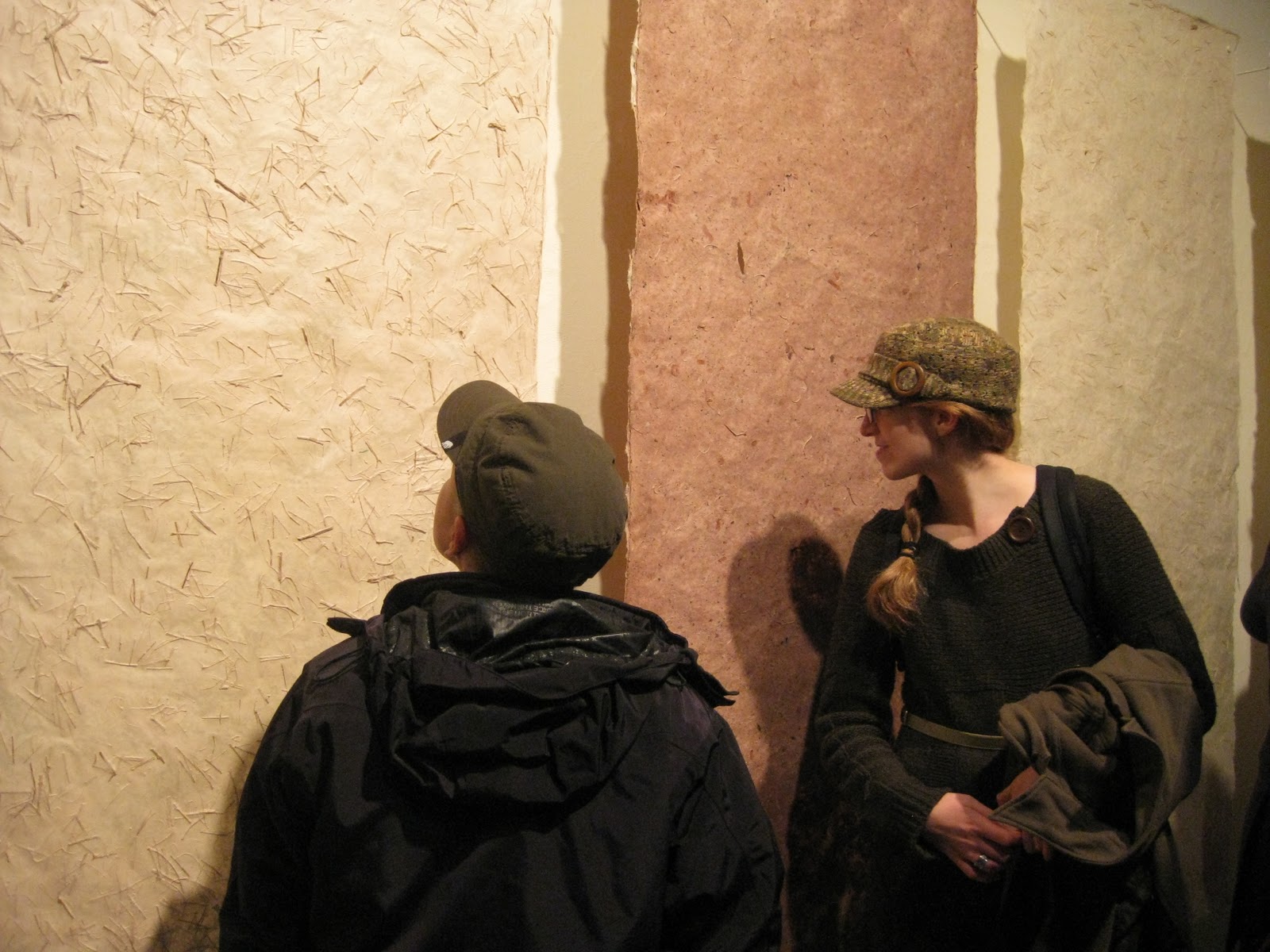


I owe a debt of thanks to curators Hanna Regev and Justin Hoover, for all their hard work putting the exhibition together.

Get Lucky is open till January 26, when there will be a panel discussion about John Cage and a closing reception from 6-9 PM.
Saturday was the final day of the CBAA conference, and papermaking was featured in not one, but two panels! Unfortunately, they happened simultaneously, grrrh, so I only made it to one. Since then I've gotten some rest and begun a new to-do list for January. Thanks to everyone who came out to either of my exhibitions, and I'm hoping that this week's good fortune is providential for the rest of the year!
Tuesday, January 3, 2012
New Year and a Jentel Wrap-Up
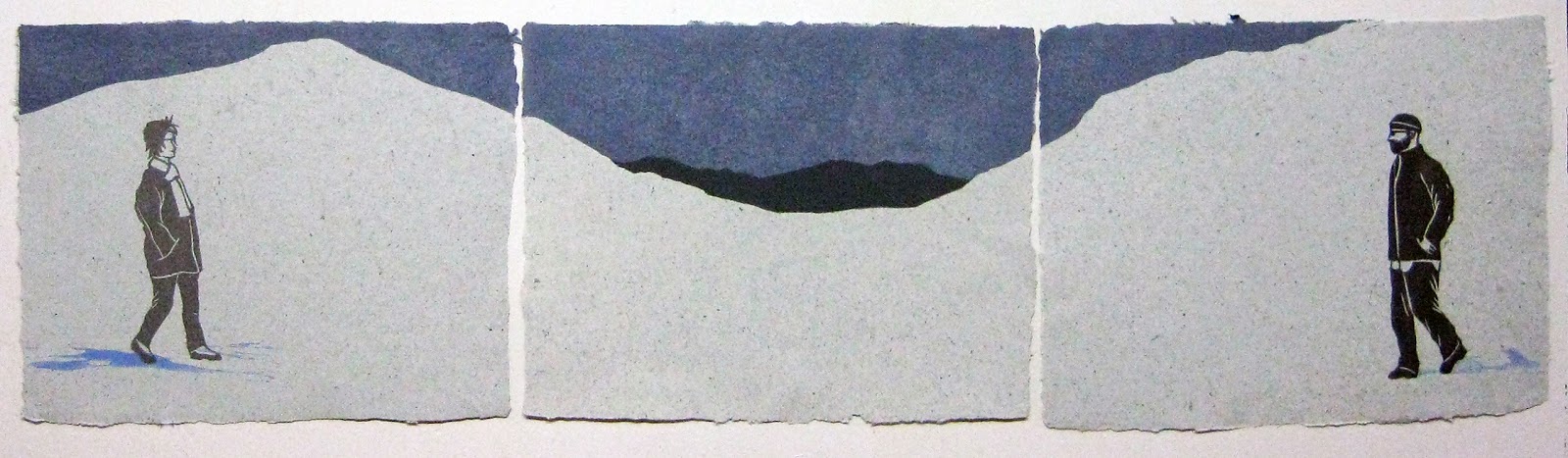
My friend Steph has a family tradition of doing laundry on New Year's Day. I think the idea is to set a tone of accomplishment rather than procrastination for the year. I've been meaning to write up a conclusion to my Jentel posts, to form some sort of completion to its narrative on this blog. Today is January 2, not the first day of the year, but I'm finally getting to writing something, though I'm not sure I've figured any of it out yet.
While there, I started processing how I've become a caretaker to someone who is ill, and all the implications and changes that this is going to mean for my life. I also spent a great deal of time feeling alternately guilty, angry, or worried (I was so lucky to have good people around me at Jentel who helped me deal with these feelings). At the same time, I kept thinking about the ideas of healing within the landscape, which led me to piece above (detail below), placing me and Robert within it, hoping that by envisioning health it could come to us. (Also why I didn't post images of it before - wanted him to see it first)!

Though I have to admit, so far, no such luck. Last week, after puttering around cleaning up my studio (always puts me back in the groove), I finished the last triptych that I started there. During the last few days I had run out of blue ink, so it had to wait till I was home for the last layer. I'll post the full triptych soon, but here is one of the completed center print hot off the press:

Have to admit, I loved the intimacy of all the hand-printing I did at Jentel, but on a press it goes SO MUCH FASTER.
The suspicious part of my brain wanted to believe something like, if I finish this triptych (which also has Robert in it in another panel) maybe he will get better. And he did seem to be improving for a day or two last week. Still in pain, but more present. And then he took another bad turn and my hopes were dashed again.
In the past two days, I've been repeatedly asked if I'm depressed about my current situation. On the phone this evening with a friend, they said something about how I need to keep my hopes up. Thing is, I'm finding it more difficult to deal with my hopes being crushed repeatedly as we explore treatments that don't end up working, and I would rather just let them go. A few days ago I read something about making peace with uncertainty in regards to illness, and I think that's a good summery for where I am. I don't know if that's depression or not, but I feel better without the ups and downs.
At Jentel, I slowed down, I was not my constantly-rushing self. Part of my typical acceleration comes from ambition and planing planing planning for the future so much I'm never in the moment. I'm trying to hold on to this new unhurried demeanor, and allowing myself to proceed at a more measured pace through this uncertain time. Concentrating on just being in the now, and taking it day by day.
Tuesday, December 20, 2011
Sneak Peek: Installation at SOMArts

I need to write a post concluding my experiences at Jentel, but the day after I arrived at home I had to install my piece for the exhibition Get Lucky, the Culture of Chance, at SOMArts. Just jumped back into my life, and I haven't had a chance to process my final Jentel days or photograph the work yet. I will soon.
This are some images during installation of my piece there, before lighting was adjusted. The show is responding to ideas of chance, particularly in reference to John Cage. Responding to Cage, I made a series of edible fiber papers. Despite being a native of Los Angeles, when Cage worked with Beverly Plummer to make his papers, they used fibers from the East Coast. I wanted to explore my new West Coast home. Above is a panel made from ice plant. Interestingly, ice plant, when cooked in soda ash, turns a rich purple. I suspect it would make a lovely dye, which I will have to investigate further.
Below, from left to right, zucchini, corn, mint, iceplant, sunchoke, artichoke, fennel.

Other than artichoke, I'd never worked with any of these fibers before. This experience has introduced me to many possibilities in the landscape of my new home. As for chance, it's made me consider the idea of greater chance in regards to weather, and harvests, and how that influences what grows and what survives.
The opening reception for Get Lucky is on Friday, January 6, from 6-9 PM, and the show will be up till January 26. SOMArts is located at 934 Brannon Street in San Francisco. Hope to see you there!
Wednesday, December 7, 2011
Wyoming Dispatch: The Petrified Forest and Reaction

As our days at Jentel are nearing an end, we residents took a spontaneous trip to the Dry Creek Petrified Forest. It's one of numerous petrified forests in the state, but the only one I've gotten a chance to see. It's the remains of swamp trees - the high desert of Wyoming used to be a swamp - and before that, it was under a very large sea. In some ways, as you look across the undulating landscape, you can imagine it.

Most of the forest is underground and un-excavated, and what viewers see are the remains of stumps. Only one large piece of a megasequoia has been unearthed.


I kept thinking about these petrified trees as artifacts of time. Dan at one point joked that petrified trees don't burn, to which Jennifer countered that the exception to that was coal, reminding me of my own artist book on the subject.
After our visit to Devils Tower, I had been thinking about how, after the exposure to its grandeur (not to mention its cinematic history), I personally, couldn't make work about it. Most of my work involves constructing narratives that are implied onto the landscape, and I just didn't feel right doing that to such a sacred site to so many indigenous people. And it doesn't feel respectful to use their narratives (not really my style anyway, I'd prefer to have total authorship). Besides, anything I'd do would end up being seen as some Close Encounters reference anyway.
But I was drawn to these petrified trees. Jentel has some ornamental petrified wood chunks in the driveway.

I'm not sure where they're from, though I'm certain it's somewhere in Wyoming. Once we were home, I grabbed some of my paper and a box of oil pastels left by a previous artist (thank you whoever!) and went down and made some rubbings of their surfaces.
The paper I selected was some I'd actually had leftover from grad school, when I was still figuring out how to make quality watermarks. These are watermarked with the image of tree, tests for The Ghost Trees that I was never completely satisfied with.


I'm not sure how much of the watermark you can see above - that's the best I could do for backlighting currently. As I was making them, I couldn't help think of Melanie's projects, and hope that this isn't stepping on her toes. I'm not sure what I think of them right now, but I like the idea of the tree hidden in the stone, and interacting with transformed trees. As I was making them, I mentioned to Jennifer that I had to make these here, as I didn't access to large chunks of petrified wood back home, and then I remembered the Sonoma Petrified Forest. Have to make it up there soon. So maybe these are proofs, tests, or maybe they are complete. I have to think about it.
I'm really going to miss my fellow residents. As I write this, my studio door is open, and so is Dan's and I can hear him singing "Your Body is A Wonderland." Earlier he and Jennifer were singing along to Johnny Cash for their karaoke debut this weekend. When we all first got here, our studio doors were shut, we were even not sure about the rules of knocking and interrupting each other. Much has changed.
Monday, December 5, 2011
Wyoming Dispatch: Work in Progress

I've begun my last week at Jentel, and I'm busily working to try and finish things I've started. As I was working, I couldn't help but think how interesting the image above is - it's a shot of the corner of my desk, but it really captures the tools I use - woodcarving tools, thread, electrical cords...all mixed up together. Below, the blocks from this print triptych have been reduced to print another layer of sky.

Below, the beginnings of another triptych. It's got more to come, but I really love the abstraction it creates just as it is. They remind me of the some pieces I saw by Nadia Myre with Marie a year or so ago at the Museum of the American Indian. I remember something in her statement, about how when a land is special or sacred to you, the horizon line becomes more meaningful than just a marker for where the sky meets the ground, it's a demarcation for where your home is, where your beliefs are, where the entire story of your being and your community is based.

I'm really enjoying working this way - my little sheets of paper aren't long enough to capture the panorama of this landscape, but I also love how working this way is opening me up to some new directions.
I've spent some time these past two days thinking about this article in the New York Times. On one hand, as an artist working in a craft tradition it's exciting to read of recognition of artists working in similar veins, ideas, and traditions. On the other, I have a lot of problems with it. First of all, the bias is towards Europe, particularly Paris, and as Jennifer pointed out, is completely ignorant of the fact DIY working methods have been thriving here in the States since the 90ies. She added that it makes no mention of its historic ties to the feminist movement, or Riot Grrls, (I would also add Asian traditions like mingei) and while touching on how artist often turn to these working methods as a refusal to participate in consumer-driven mass produced art, adds a simpering mention of how its "cheapter too!"
It is also ignorant of how craft practices have a long tradition of serving as forms of protest and activism, treating it more like some sort of fashion trend.
Beyond these ideas, it does not touch on the philosophy and reasoning that drives artists to a craft-based working methodology. As a hero of mine has said, Paulus Berensohn, has said, working with craft materials, materials made directly from nature, means that its final product directly invokes its origins in the natural world. Though it does mention how Jeanne Briand uses her breath to make her blown glass, it avoids further discussion of how craft processes involve the human body. Most craft techniques evoke the human hand. Judith Schaechter has commented that this is why craft programs are often being cut or reduced, as this tendency also reminds viewers of the inherent messiness of the body.
I would suggest that artists are drawn to working in craft traditions because they are drawn to using their hands and bodies. Working by hand creates an intimacy with materials, a use of the hands/body as a tool, a relationship with the entire experience that is making. Between this intimacy, relationship to the body, and an affinity with the natural world in my materials, there is a world of craft philosophy that demonstrates that artists who choose to work in craft traditions are doing so with a deep convictions.
Subscribe to:
Posts (Atom)