Friday, May 18, 2012

A vist to Lost Coast Culture Machine!


The focus of my trip to the North Coast was for Lost Coast Culture Machine's first invitational portfolio, of which I'm a part. LCCM is stationed in Fort Bragg, a lumber mill town that in recent years hosted a Georgia Pacific/Koch Brothers mill, the remains of which dominate the most of the downtown coast. (Image above is from a 2008 article on the Mendo Coast Current, which discusses how to properly remediate the soil on the GP site).

With the town's legacy as a mill for paper products, Anne Beck and Dietmar Krumney founded an alternative exhibition space and a sustainable hand paper mill, Lost Coast Culture Machine.

Click on any image for a larger picture.


In the spirit of DIY, they've built all or most of their equipment. For instance, this couching table:


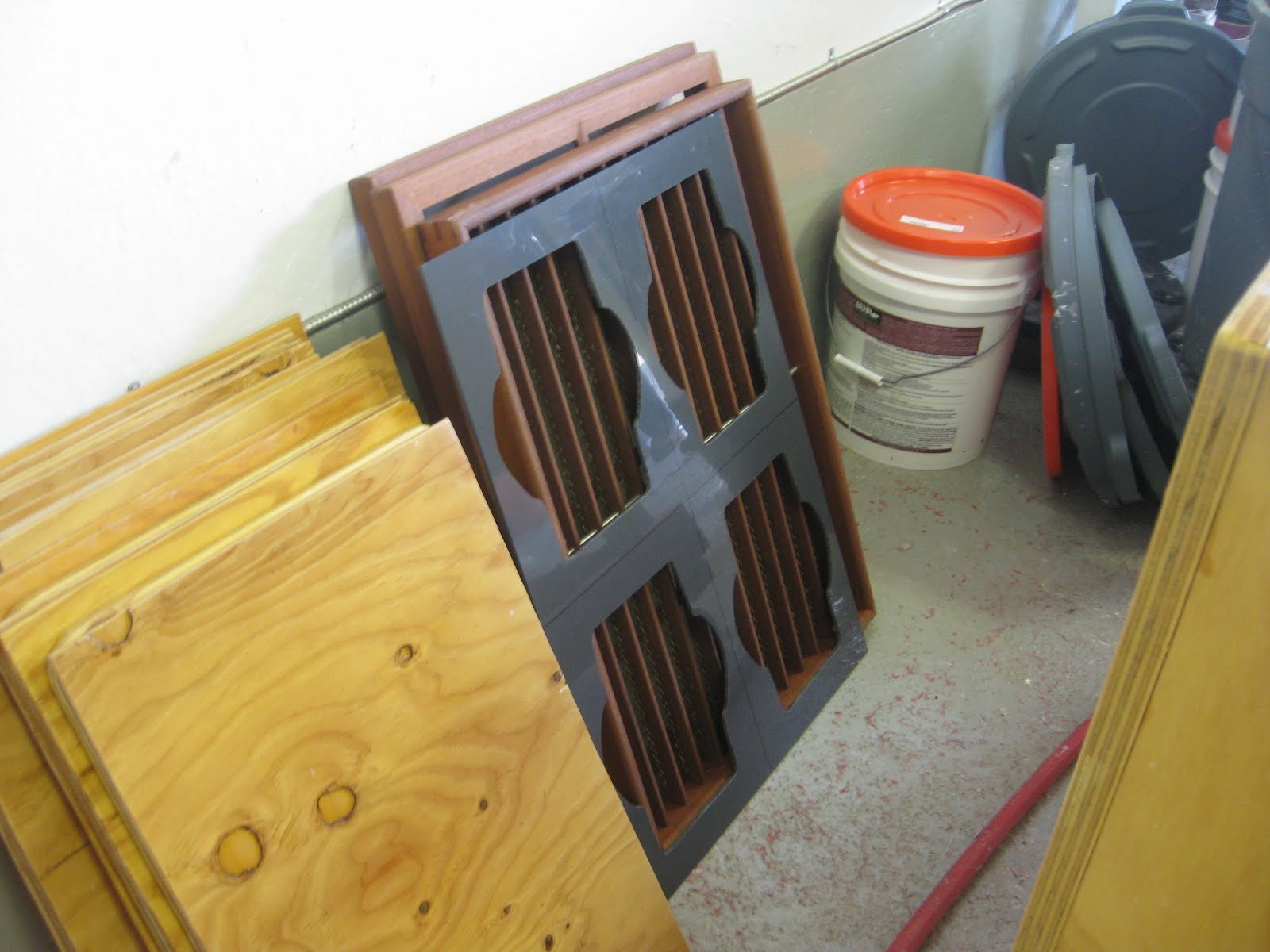
They did admit to hiring a woodworker to build their molds, though Anne sewed the screens on. Below is one of their molds with a an multiple envelope deckle.

Their paper press:


Their beater, which came from Chillicothe, OH!


Something I thought was completely ingenious was their drying system for pellon and felts. It's a hanging rack system that can be raised and lowered so that it doesn't take up workroom. I wish I had the space for something like this in my basement studio, but alas.


These papers are offered for sale through their store. This table shows just a selection of what they offer:


As part of their sustainability program, they are harvesting local fibers. They recently worked with the Mendocino Land Trust to harvest pampas grass.


Some local fibers they get at the thrift store. Here's where they store them, sorted by color:


Other papers they've made:


No studio is complete without a poet hanging around. LCCM has Virgil to guide them.


I'll be posting updates as they get the portfolio online. Sales will support LCCM, in particular, the artist-in-residence program they are developing.

Tuesday, May 15, 2012

A visit to Stanford and the Cantor


A few weeks ago, I had a chance to visit Stanford University and see the Cantor Museum. This precedes my trip up north, and I thought I'd take a break from my irregularly scheduled programming to post about it. Stanford, if you have to ask, is a gorgeous campus. The picture above is their church, which is designed in a mixture of Romanesque and Byzantine styles, and executed in way that feels authentic rather than imitative.

The Cantor has a small but impressive collection. For instance, it was my first time ever seeing a Duane Hanson sculpture in real life.


It was positively creepy - I keep seeing the figure out of the corner of my eye and thinking there was a real person there, even after I'd read the label and with knowing who the heck Hanson was to begin with!

Get a load of the details:


Another artist I had heard of, but never experienced their work outside of photographs was Richard Serra.


I'd never been too impressed with him from photographs (C'mon, big steel things! I'm over Big/Overwhelming=Good Artist). But I'll grant that actually walking through a Serra changed my mind. Due to the tilted nature of the walls, you have to be cognizant of space, otherwise you'll hit your head.


Which I'm sure was his intention - to make the viewer uncomfortable.


However, I also found myself intrigued with the labyrinthine nature while inside it.


In front of the Cantor was their newest - installation? Acquisition? Not sure. A work by Andy Goldsworthy.


I usually love Goldsworthy, but this piece felt lacking. On one level, its winding nature speaks to the Serra a few hundred feet (and behind a high wall) away.


I wasn't sure how I felt about it being sunken. I walked down into the piece and around it, and it didn't seem to add to the piece at all.


In fact, I like the piece better in these pictures than I did when I was actually there - I'm not sure what that means. It felt to me that this piece, in this arid, sandy environment needed to engage the landscape more - like there should have been water rushing through it, and the reason for the wall's curves was to guide the water. On the Cantor's website, it states, "Set in a trough in the earth, the sculpture gives the appearance of an archaeological excavation. Over time, the land around the work will return to its natural state and animals will settle into the site. The stone has traveled full circle: quarried initially for Stanford University buildings, it now returns to the earth in another form."


I like that idea, so...maybe I'll like the piece more later.

I know I've chosen to write here about three white guys, and the museum, like many, is pretty white-guy heavy. In deference to this, I'll say I really enjoyed the exhibition of contemporary Chinese Art - particularly the Xu Bing - but out of respect for works on paper I didn't take any pictures. The collection of Native American art - both historic and contemporary, is pretty impressive and I was glad I got to see that as well. There were also statements posted by Stanford students reflecting on the work for visitors to read, which contained some pretty insightful and eye-opening revelations. It seemed to also emphasize that university museums like the Cantor really do belong to the students, as much as their libraries and classrooms should.

The Cantor has free admission, you don't have to be part of the Stanford community to go see it, and I recommend it!

Saturday, May 12, 2012

Mendocino and Fort Bragg


Last weekend, Robert and I headed up the coast to visit Mendocino and Fort Bragg. It felt very spontaneous, as we decided to do and went two weeks later, which probably says more about my life and my definition of spontaneity than anything else. It wasn't just a getaway, I was part of an invitational portfolio for Lost Coast Culture Machine, which I'll write more about later. Meanwhile, here's the post on making that print.

We treated ourselves to a stay in a cute little bed and breakfast - which was basically across the street and down a short path from the cove above. Below is another part of the cove.


The village of Mendocino is on a peninsula, surrounded by the Mendocino Headlands. I took a few walks around parts of it.


I can't get over my fascination with arch rocks. Geology and negative space just enthrall me.

In "downtown" Mendocino, I was intrigued by the architecture - I'm not sure they are still in use, but several buildings seem to have their own water towers or window's walks of a sort.


I also headed up to MacKerricher State Park, which has one of the few beaches that you can walk on. Most of the Mendocino Coast is dramatic cliffs overlooking the ocean. At McKerricher, there's a seal colony, and they were whelping.


By and far my favorite thing was shown to us by Anne and Ditmar of LCCM. It was a capacious tidepool north of the city of Fort Bragg.


Viewing the waters of the North Coast was the first time I ever fully recognized the ocean as a complex living entity. Intellectually, this was something I recognized, but it was never something I felt down to the core of my being like I did on the shores of Mendocino County. The waters are so full of life there, it feels like one living thing. Its almost as if the tide is its breathing.

As we reached the tidepool above, the tide started coming in, bringing new water. Anemones, urchins,mussels, seaweed, and other things I didn't recognize woke up and started feeding.


Click on pictures for larger views.

Monday, May 7, 2012

Becoming - new print for Lost Coast Culture Machine!


This spring, I was asked to be part of an invitational portfolio to support Lost Coast Culture Machine, this totally awesome, amazing, alternative exhibition and papermaking space up in Fort Bragg, CA. Book Bombs was part of an exhibition with them a while back, and since I've moved to California, I've been meaning to visit. More on that later.

For this portfolio, each artist was given some paper (see mine above) made at LCCM, to which they were asked to respond to this following quote by Giles Deleuze, One should seek to create a foreign language from one's own language, to be spoken by a community that does not yet exist. Not being too familiar with Deleuze, my first step was to sit down with my knowledgeable friend and philosopher Phil King (who currently has some paintings up at the Bay Area Free Books Exchange - go see them!).

My first response to the quote, before even talking with Phil, was that Deleuze spoke of a form of rebirth. As I came to understand, Deleuze was interested in breaking free from convention, reality, the mundane, but rather than attempting to reach a higher plane or truth, he felt that truth was found in the act of escape itself. The in-between interval, the interstice, was where he wanted to stay. When talking to me, Phil mentioned Heraclitus's concept that it is impossible to step in the same river twice, and how Deleuze would answer this by saying instead of stepping into and out of the river, or across the river, try to place oneself within the constantly changing waters.

I liked this idea: constant change, constant becoming. As an representational image-maker, I also liked the idea of the river. When considering process, philosophically the idea of reduction block, something that is constantly carved away to make the next image layer, seemed to reflect the ideas of the Deleuze as well. I started with this layer of very transparent blue:


The second layer was a rainbow roll of two different colors - below you can see how it was rolled, and then the print:


I was originally intending to carve away the mountain shape down to the border of the water, but I felt the image would flatten out too much without something to imply depth. So I cheated. the next layer (the darker green mountain shape) was not part of the original block. In the interest of time, however, I printed the sandy beach at the bottom in the same run, which was.


I almost left it at that - but I wanted the water to feel more watery, so a very transparent bluish silver was printed next:


Finally, reducing the block to almost nothing - the completed print, Becoming:


For those who might not recognize the scene, it's based on the view from the beach at Miller-Knox, looking towards Mt. Tamalpais. Instead of Heraclitus's river, I have the waters of the San Francisco Bay. Hydrologically, the estuarial waters of the Bay are part ocean, part fresh, and their salinity changes depending on the amount of rain the region receives. With their currents and rising and lowering of the tides, they are a state of endless flux. I see the figure in outline dissolving into their state of constant change.

For an six-color edition of 50, not counting extras printed for mistakes, the block ran through the press around 300 times. I can't even imagine how many passes of the roller I did. As it neared completion, Robert and I decided to use this print as an excuse to finally head up the coast to visit LCCM and see the Fort Bragg/Mendocino area. More on that to come - check back!