Saturday, November 19, 2011

Wyoming Dispatch: Snowfall


A few nights ago, the Jentel crew went for a night out in Buffalo, at the historic Occidental Hotel. It was their weekly bluegrass night. It was a good night to go, as early the following morning Wyoming was hit with another snowstorm, and we residents are now physically cut off from civilization.


The snow, stillness, and silence are a gift, not only in beautifying the landscape, but providing a setting that allows focus. I have begun carving some blocks today. 


Right now, these are some of our only neighbors. Certainly the only clearly visible ones, we also have deer (both white-tailed and mule), elk, bald eagles, golden eagles, magpies, porcupines, cats, and others I'm sure.


Friday, November 18, 2011

Wyoming Dispatch: Arrival


This week I arrived in Wyoming as an Artist-In-Residence at Jentel. The day before I landed, Wyoming had its first snowfall. Jentel is located just outside of Sheridan, near the Big Horn Mountains, which can be seen in the photo above. Below is the building that houses the artists' and writers' sleeping quarters. The studios buildings are behind it. 


The residence was designed by the founder of Jentel specifically for this program. Cathedral ceilings, artwork, and only one right angle in the entire building give it a open, but rambling feel. Below is our living room and dining area.


The stairs from the living room lead up to the media center and library. I really like the odd shapes of the wood on the staircase.


Below, the front entry to the residence:


Our magnificent kitchen. 


My bed! Very plush. 


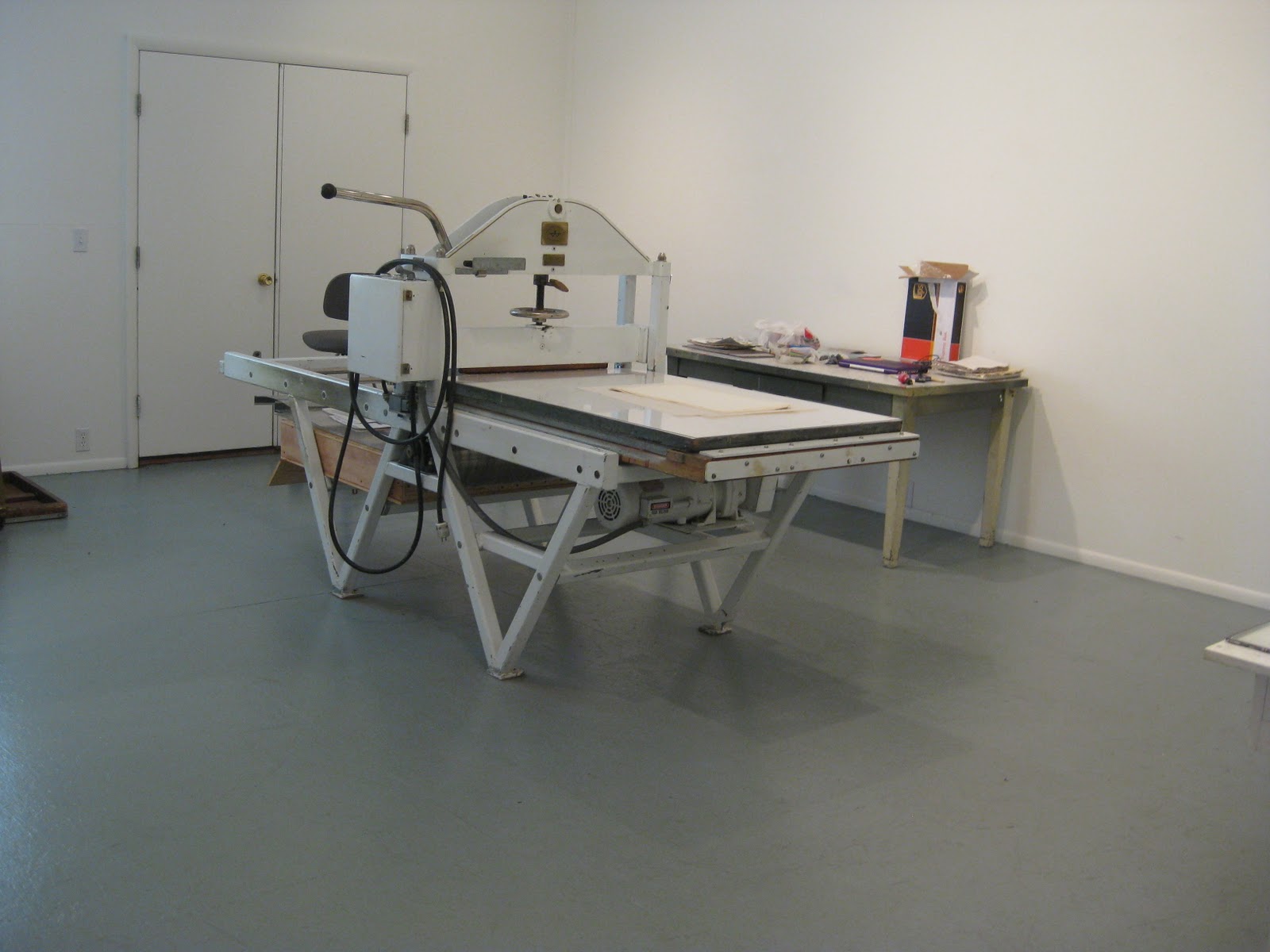
And my studio - here you can see Blanche, my studio mate.


And here is one of the property supervisors, with the slightly obvious name of "Gray Kitty." She makes the rounds and keeps everyone in line.


I'll post more again soon, but the internet connection here is extremely slow, so uploading photos takes a while. Check back soon!

Monday, November 7, 2011

November 2011 Update


With November's arrival, I'm on the verge of leaving for Wyoming for a month at the Jentel Arts Residency Program. I'm still kind of in shock that it's really happening. I'm hoping to spend a month making prints, as it has been a while since I just made prints without them being part of some greater, more complicated project. Though I'm sure I'll find a way to make things more complicated when I get there.

In other news, I was recently invited to write a piece for Felt and Wire on my papermaking practice. I'm also looking forward to being part of two parallel exhibitions this winter after my return from Wyoming, one at SOMArts and one at the San Francisco Center for the Book, both curated by Hanna Regrev and focusing on artists responding to the work of John Cage.

Book Bombs has also released it's sixth zine, Horizontalidad, available in both print and PDF versions. This zine is a response to the Occupy movement, and the print version was printed at both the Crane Paper Factory and Melanie Mowinski's Press: Letterpress As A Public Art Project, both in Massachusetts. Out of all our zines so far, I'm proudest of this one. Not just because it's our most recent, but because I felt that we tied our concept into a larger, greater whole, speaking to the moment of now, but tying it to other movements and philosophies.

Finally, I'm still selling this piece on Etsy to raise funds for Robert's parents to rebuild their lives after Hurricane Irene. The print has been purchased by the Special Collections of the Newark Public Library and the Free Library of Philadelphia, as well as a few individuals, but there are still some left!


Monday, October 17, 2011

Hurricane Irene, Rancocas Creek, 2011


Earlier this fall, Hurricane Irene slammed into the East Coast, causing New York City to shut down its subways, huge evacuations, and massive flooding.  Robert's parents, my in-laws, evacuated to their daughter Nancy's house on higher ground, where everyone safely road out the storm. 

However, after the rain dispersed, my East Coast family returned to Rancocas Creek to access the damage. To get to their home, they had to wade through about a half-mile of water, and found to their dismay that there was considerable damage to their house, and that all their belongings were destroyed. 

In order to help them rebuild, I have created the print above, Hurricane Irene, Rancocas Creek, 2011, based on photographs of the flooding. It is a two-color linocut with variable pulp paint on handmade rag paper, in an edition of thirty. The print measures 11" x 8.5" with a deckle edge. Sales of this print will be used to help them rebuild their lives, and can be purchased through my Etsy store, or by contacting me at michelle (at) michellewilsonprojects (dot) com.


Friday, October 14, 2011

Getting It


I had the fortune to be asked by the lovely Nancy Willis to be part of the exhibition Discrepancy, living between war and peace, at the Napa Valley Museum this year. For which, I created the installation above. Titled Power, it is a cast shadow (made from handcut denim paper) of an oil rig.

Nancy said the inspiration for this exhibition was the cognitive dissonance she felt while living in Napa, which if you've never been there, is a helluva GORGEOUS place, and the knowledge that wars and related atrocities were taking place in other parts of the world.

When asked to consider these ideas, I found I wanted to say something about what bridges the gap between American lifestyles and war - our love of fossil fuels, particularly petroleum. I decided that it should take the form of a cast shadow because its ubiquitous presence in everything I do, either in the forms of energy or plastics. It's there, but it so vast and overshadowing that we, as Americans, don't even see it anymore, yet our need for it is enough to send our nation to war in order to control petroleum-rich locations.

At the opening, several people came up to me and mentioned they liked my work, and then asked me what it was about. At least one person said as politely as she could that she didn't get it. On one hand, this says to me that I was spot-on in the omnipresence of petroleum - people can't even see it as an issue. On the other, the artist in me (who has similar conversations very frequently when she is expounding half-formed ideas to Robert), wants to shake them and say, "What's wrong with you?!?!? Don't you get it??!?!" More due to my vanity than any other reason.

I remember in graduate school having a discussion about how, if a viewer didn't understand a work of art, the artist has failed them for not making it clear enough. (I know this opinion differs from a part of the art world that makes work responding to art theory, and so creates pieces that have a certain inscrutability to a large portion of the population who hasn't read the same esoterica). However I couldn't help but wonder what this reaction meant in this situation. Did I fail? Or is my interpretation of the theme just cattywampus to the way most people seem to think? Or is that I was so very spot-on?

The answer probably lies somewhere in the middle. In addition, I should add that several people, including Nancy herself, told me that they were glad to see I addressed the issue of petroleum dependance. I'm told that a veteran on a private tour saw my piece, pointed, and said, "That's what it's all about." So it seems I didn't fail all viewers.

As I muddle over these reactions, I can't help wondering what the next incarnation of this piece should be. It seems like just the beginning of a larger exploration.

On a lighter side, I had a small brush with big celebrity during the opening reception. Robert Redford showed up (his wife is one of the artists in the exhibition). Here I am, blushing madly, with him and Kristie Sheppard, the director of the museum.

Monday, September 12, 2011

A Visit to SF Zine Fest


I meant to get this post up before now, but alas, always so busy! I visited the SF Zine Fest during the first weekend in September, held in the County Fair Building in Golden Gate Park.  It was an afternoon spent in the aesthetic of DIY.  Above is my friend Jennie Hinchcliff of Red Letter Day.


As I was reading various review and posts of Zinefest, one in particular spoke to me. The Bay Guardian had a feature called No Zine is An Island, which reminded me that making zines is more than just paper and ideas, it's participating in a entire community and subculture. 


Definitely got me thinking about next year. Hmmm....Book Bombs.....we'll see what happens!

Monday, August 22, 2011

Assignments in Curating


Note: The post below was an article I submitted in 2010 to the blog Postcuratorial.com, before its author had to abandon it for other projects. Since it never saw the light of day, or more accurately, the backlight of a computer screen, I've decided to upload it here, with a few slight revisions. 


A repetitive theme in exhibitions is something I have started to refer to as “assignments,” typically, a curator comes up with a very specific duty to be completed by artists as the basis for an exhibition. Assignments generally focus on a specific material, such as aprons, or actions  in which artists are assigned the task of making work around this concept for an exhibition.  Artists tend to respond in one of two manners – those eager to build their resumes, return to their studios to complete the project, others saunter home, to forget about their homework until the last minute, upon which they throw together something disappointing.

There is something enjoyable and stimulating about occasional participation in such an exhibition. As an artist, I’ve even participating in some (see above image).  Given the right circumstances, there can be benefits to the artist. I have found the occasional assignment can provide a challenge that encourages experimentation or open up a new direction in my work. Interesting discussions may ensue when different artists confront the same project. 

I was recently (in 2011) met the coordinator of an upcoming juried show that explored the idea of women looking at men, who encouraged me to enter. (I should note here, as someone who has organized exhibitions, there is often a fear that there will be lack of submissions, or a lack of good submissions, and so I understand where she was coming from). I replied that I felt that I could not, as the central concept didn't fit into my body of work. She gushed, "Oh, but this is an opportunity to make something new!" and went on to describe the project she was planning to enter, which sounded great. And I concede her point, but I find myself thinking, don't I have that opportunity every day I go into the studio? 


From a curator’s point of view, I can also see the appeal:  upon successful completion, a curator has a cohesive exhibition.  For some artist-curators, such as Little Berlin’s Offerings it can be a fun experiment and easily promoted to the press. However, I believe this concept has been largely critically unexamined. 

In traditional art school, professors require students to learn specific techniques (ie. plaster casting) through projects, for the purpose of building knowledge for later use in their emerging visual voice. Past art school, what is implied when curators feel they can give artists homework?

Often these exhibitions are a means of fundraising, though I cannot comment on their success rate. However I must wonder if it is beneficial for both collectors and artists to have artwork purchased that may be outside of the artist’s oeuvre? When boiled down, I believe the real question is, will artwork created for such a project stand on its own, outside of the assignment-exhibition?  

As an artist, I want to make focused bodies of work. Personally, I only have so much time to do so, as everything takes longer than I ever think it will. When I was a younger artist, I was more willing and eager to take part in such assignments, but now I feel that for me, they are distractions from making the real work. If such an assignment fits into my overall focus, which means that I am working with a thoughtful curator, it is worth it. It also suggests to me that the final exhibition will be a considered set of ideas, rather than a hodge-podge of miscellany.