Showing posts with label fibershed. Show all posts

Sunday, October 28, 2012

Fibershed Papermaking Workshop


This month has been a whirlwind, and I've barely been able to keep up with this blog, as exemplified by the tardiness of this post. Two weeks ago I taught an intensive papermaking workshop for the Fibershed. Specifically, it involved a group of teachers from the Marin County school system who are incorporating sustainable and bio-regional art making activities into their curriculum.

The class covered how to paper from vegetables, invasive plants, and clothing. Here, some students harvest Andean Pampas Grass seed hair.


The class also covered various preparation methods, from hand beating, to blenders, to the beater itself. Many of the teachers really liked the idea of a classroom full of kids expending their energy by hand beating fiber, but to me it sounds like a cacophonous nightmare.


After learning about prep, we moved on to actual sheet forming. I also discussed techniques on preventing water from getting everywhere in a classroom situation. Over the course of the day, I kept making jokes about kids and how they react to various art classroom situations, and how I tend to handle them, which kept the teachers amused. One even commented that it would be very entertaining to watch me handle a group of kids making paper.


It was a great class, and great to share papermaking with a group of enthusiastic people who asked so many good questions, danced around my studio, and kept me on my toes the entire day.


Thursday, October 25, 2012

Studio Photos


I recently taught a papermaking class through the Fibershed in my studio. In preparation, I had asked Robert to organize his tool corner of the studio. Instead, he went above and beyond and organized the entire space for me, winning the Ultimate Husband of All Time Award, I think. Before the workshop, while it was set up in preparation for the class, we shot some photos of the space. Above, you can get a good idea of the size - it's about 900 square feet or so, and the reason we decided to rent this house.

The drying area, for prints and pellon. We had built the drying racks back in Philly, using nylon window screening and cheap stretcher bars bought with a coupon at Jerry's Art-A-Rama.


Organized printing and inking tools:


The glowing portal in the back of this photo is the door to our garden, a space I often use for the very wet part of my projects, as well as cooking fiber:


Of course, now that it's all organized, I can't find anything!

Saturday, July 21, 2012

Fibershed Camp Papermaking Workshop


This week I was so happy and excited to teach a workshop for the Fibershed Camp! My workshop was the last day of their camp - before I came, they had been dying, felting, weaving, and generally learning the basics of how to grow and/or raise their own fiber, as well as the understanding of issues of locality and sustainability in relationship to the clothing industry.

And on the last day, they got to learn how, after their clothes wear out, they can be re-purposed into paper!

I wanted to give the kids the idea of how something like jeans become paper, so we began with the kids having a chance to cut up some jeans. I was a little nervous that the kids would instantly become bored with such a beginning, however this group was blessed with good attitudes. Other than the issue of lacking any left-handed scissors for one child, they all seemed excited to chop up some jeans.


However, I ddin't want to lose time beating (and moving my beater is a whole other issue), so, as Rhiannon likes to say, we did it cooking show style. As they were cutting, I explained how this fiber would need to be soaked and beaten, and then voila! brought out the pulp I had prepared in advance.

Once I pulled out the pulp, the kids couldn't get their hands out of the bucket. We almost had to physically pull them away so they could learn to actually make the paper.

But once we got started....


...things just took off! Some of the tables were a little tall for the kids, so some took to standing on chairs to reach the pulp.


Below, Rebecca and a camper pull sheets.


Finally, the paper was pressed and transferred to paper towels for the kids to take home.


My workshop was in the morning; my afternoon was just spend hanging out at the farm and getting to know the kids a little bit.


The garden has certainly grown since my last visit!


The coreopsis was blooming while I was there.


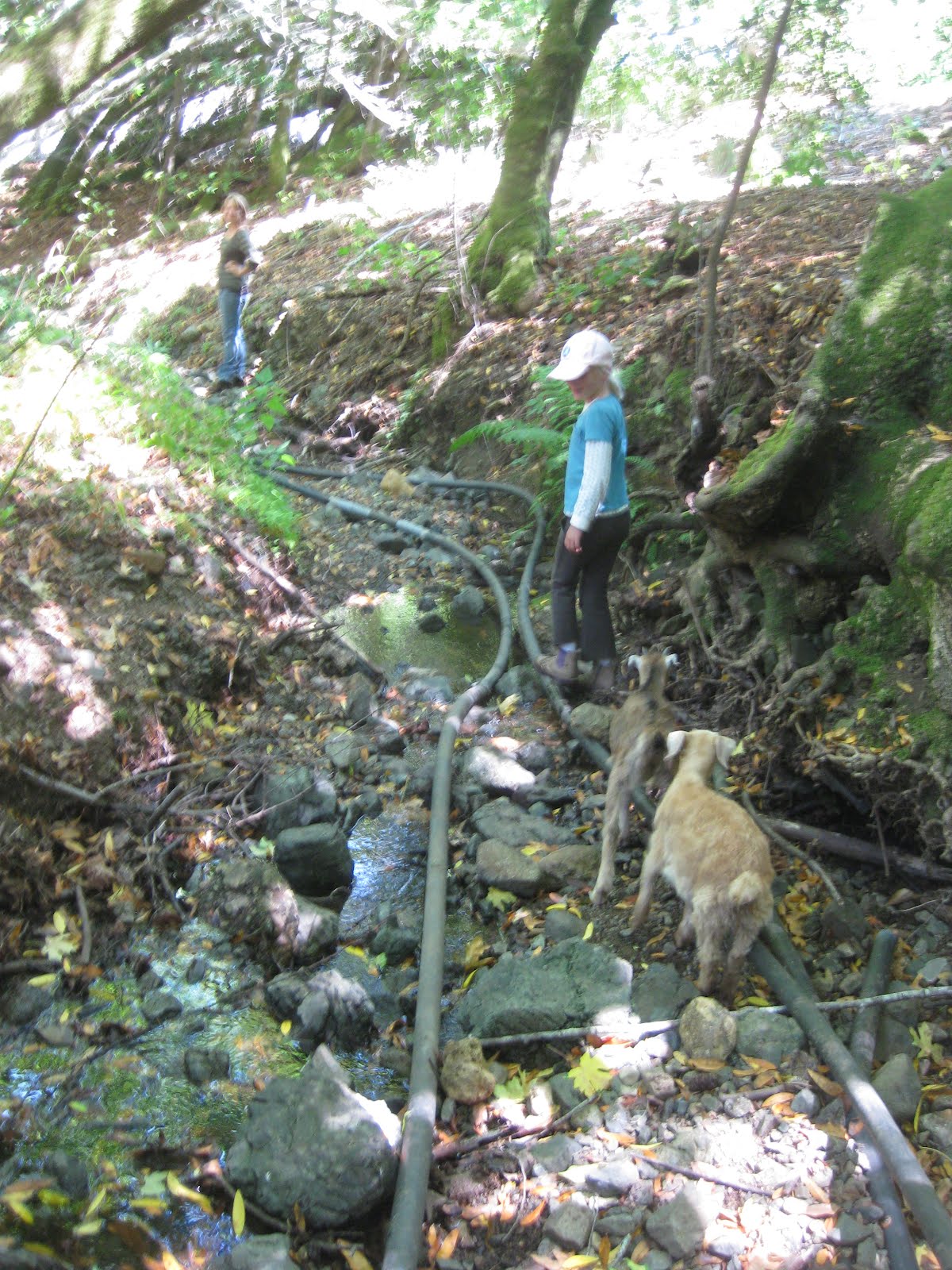
After lunch, I went with Julie, the kids, the dogs, and the goats on a short little hike to see the waterfall on her property.


Spending time on Julie's farm makes me dream of moving to rural Marin, planting flax and starting a full-on papermill. Heck, Lagunitas Creek was once known as Papermill Creek, so there's evidence of a precedent. If only....

Monday, July 2, 2012

Fibershed and Community


Last Friday I headed across the water to Lagunitas to meet with some of the mavens of the Fibershed project. I'm going to be teaching a papermaking workshop for their day camp. We had a lovely conversation around the esoterics and logistics of fiber, plants, craft, and the possibilities of making.

And they have goats. Goats!


And baby goats!


The vegetable garden:


A sun shed with a small "greenhouse" for sprouting seedlings on the side. It was built from an existing structure that needed repair. All the windows were found on the property.


The farm where they host their camp is an old carmelo walnut orchard. The trees were planted by the former tenant of the property, and now are around forty years old. Lot of nuts to eat and dye with....


Before I left, they let me help myself to the broom plants - or rather, weeds - that are popping up on the property, to see if they have paper possibilities. I'm going to see what I can do with them.


So much paper to make! I wish I had more time.

Tuesday, May 29, 2012

Chiritori


It was a productive weekend of fiber preparation. I decided to go ahead and make paper from some of the dried plants I'd been hoarding, although I'm not sure what I'll be doing with the paper once it's made. Meanwhile, it provided a lovely opportunity to spend time in my garden. Above, the fiber is cooking, near plants with paper potential - yucca and rose-of-sharon, with some calla lilies that appeared, as well as white sage.

I began the weekend by stripping the bark off of the stalks and soaking them in water.


After stripping, the bast fiber is cooked in soda ash, as seen in the image at the top of this post. It cooked for several hours, and then sat in the liquor overnight. The next morning, it was rinsed, and then I commenced to pick off the remaining little bits of bark on the fibers, in a practice the Japanese call chiritori.

It was the first time I ever really spent an extensive span picking chiri. I've done it before, but never this intensely. I kept thinking about how in Tim's book he mentions that for a single batch of pure white paper, it usually takes about nine hours to pick it clean. At Shikoku Wagami, it takes them about two months for their entire yearly paper production.

I lost track of how many hours I spent. Yet, it was such a gift to slow down, sit quietly, calmly focus, and pick chiri. And to feel that all I had to accomplish was clean fiber. I was resigned to beating and sheet formation for next weekend, so I didn't pressure myself to rush in order to squeeze in the entire process. And after watching this, I was trying to enjoy the moment I was given to work, and to work well.

While picking, I kept thinking of the song Simple Gifts. It was a simple task to pick bark, to clean fiber, and let the part of my mind that has a continual to-do list running be quiet.


I managed to pick through about half of the fiber. Have to admit, I'm in love with the clean fiber just as it is. Of course, after all this gentle labor comes the beating.

On a humorous note, I made mention of chiritori on Facebook, and Marie, using Google translate, was told it meant "dustpan." So now I'm wondering about the etymology of the word...anyone out there who could explain it to me?

Monday, May 21, 2012

Growing Flax


I'm growing flax! Above, you can see what it looked like just as it was sprouting.

Actually, I grew some last year, which "pond"-retted in a plastic bucket over the California "winter" (no snow-retting here) but due to other deadlines and responsibilities, I've yet to make paper from it.


Denise had originally inspired me to grow flax after giving me some that she grew. So now I'm onto a second round that I'm hoping to harvest in June/July, and then maybe get a second harvest out of 2012.


So now I'm trying to figure out what to do with it, and getting over the voice in my head that says I grew it from seed! It has to be special! I'm also at a learning stage on how to process it - I didn't have a clue of how to tell when the flax was done retting. I just sort of guessed when most of the green plant matter seemed to be gone, leaving what appeared to me inner bast fiber.

Additionally, I'm not sure if any breaking, scutching, or heckling is needed. I remember seeing a video of Helmut Becker processing his flax which included a some heckling, but I can't seem to find a copy. Menawhile, in this video, I was reassured to see Howie Clark cooking up stems that look very similar to mine.

After John's talk at CBAA, I came across this - and found the idea of a fibershed (like a watershed, but with fiber) very appealing. Not just from a localvore/sustainability perspective - I'll never forget my time at Moore, and some of the Asian students who came to study in the Fashion and now-defunct Textile programs, who had mad sewing skills, because they began learning in sweatshops when they were children.

So...growing flax. The questions that come to mind, other than being environmentally conscious, why do this? As an artist, what does it mean to me?


I'm growing flax partially because, well, I can in my current situation. As a papermaker, I felt I should give it a shot. But also because I see it as a form of Land Art, that can be transformed into a more portable form. It's grown out of the soil where I live, where I also grow some plants I eat. It ties me more closely as an artist to the soil and the sun and weather of my locality.

As a form of Land Art, I see it turning around the question of the carbon cost of making (pieces like this one are visually beautiful to me, but talk about carbon footprint!) Instead, it could be asked of this piece (when finished), how much carbon did it absorb?


I'm not sure how to calculate that. Though I'll note that according to Growing Flax, Production Management and Diagnostic Guide, from the Flax Council of Canada, it states that flax is carbon neutral in regards to burning - it releases the same amount of carbon dioxide that it absorbed while it was growing, and that same amount of carbon dioxide will be re-absorbed in the next harvest.

To me, growing the fiber will be part of the final making of the piece, though I shy away from it in a way because it seems to cast me as the Human Lording Over the Earth. I'd rather think that I collaborated with the earth to make the piece, by clearing some soil and planting seeds. Which I guess also means I collaborated with the sun and rain, though most of the "rain" came out of my hose since we received so very little this year. I also recycled some papermaking graywater into the garden, creating a sort of mobius strip of making and growing.


I'm currently reading A Sand County Almanac, and thinking of making my own record of a year and my observations. Those ideas may play into whatever these fibers become.