Sunday, November 4, 2012

Riding the waves


This past week has had a strange melancholy to it. The previous week, Robert was in Stanford Hospital receiving an experimental treatment, which so far has proved to be inconclusive at best, but was most likely unsuccessful. At the same time, Hurricane Sandy pummeled the East Coast, and several friends have been without power or electricity for days.

It's so odd to be here, in beautiful, sunny California, while 3000 miles away people are cold and hungry, in places like lower Manhattan, the richest city in the world. Complicated by my personal struggle as a caretaker/my partner's health issues, I end up feeling isolated and guilty. My troubles are not shared, and do not have a an end in sight, yet at the same time, are not immediately pressing like those of people in Hoboken or Staten Island.

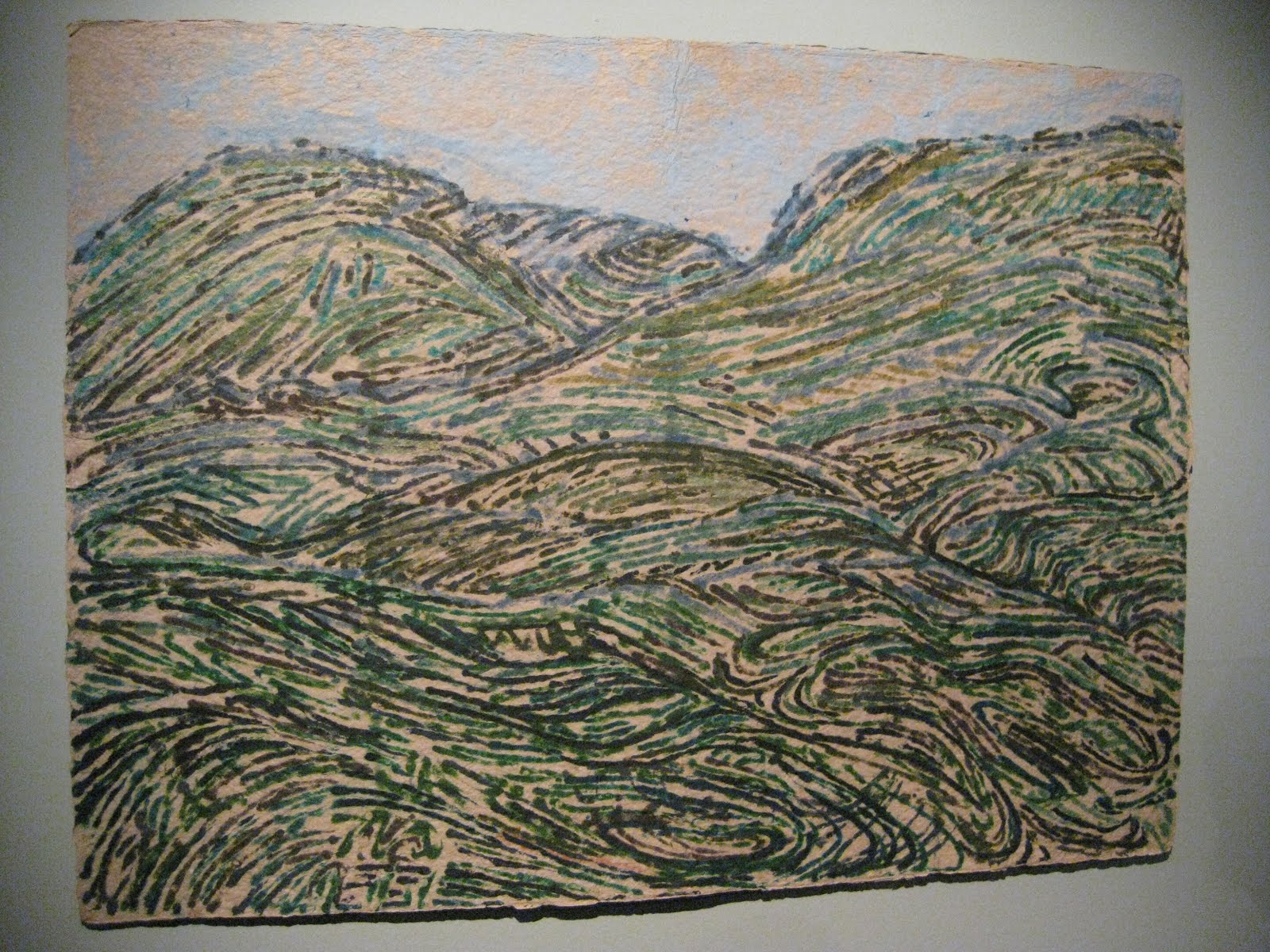
Last year, my in-laws lost all their belongings when their house was flooded by Hurricane Irene. As fundraiser for them, I ended up selling the print above, and I've found myself thinking about it a great deal this week. Fortunately, this year, for them, the creek didn't rise enough to flood their home, although they have been without heat or electricity for a week.

I find myself turning to poetry for comfort, guidance, insight. Poets like Mary Oliver, Pablo Neruda, Rainer Maria Rilke. And then, today, the poem below caught my eye. I have a copy of it on my fridge. It's been there for years, ever since my senior year of college when my teacher, Shelley Thorstensen, gave it to me. I just noticed it again after being blind to it. Shelley didn't know the author, or even the title, and I can't see to find it on Google. It may actually not be a poem, just a list of lifeboat survival techniques. But it can be an overall metaphor for getting through a tough time.

Keep riding the waves.
When there's a lull, take a rest.
If you have crackers, eat them sparingly.
Icebergs are dangerous, but are a source of pure water.
Eventually, you might see a ship. Fire off the flare gun, toward it.
Wave at all aircraft, but do not yell; they cannot hear.
If raft overturns, hold ropes on all sides.
All parties must be on the same side, to turn raft upright.
Be sure the automatic harpoon is pointed towards the water.
Rebroadcast your current location at regular intervals.
If you see birds, row toward where they fly.
Beware of using sharp objects inside raft.
Do not eat any species of blowfish.
When you hear the sound of breaking waves, be ready to make landfall.
The Bermuda Triangle is populated with giant squid, a source of protein, which will feed two people for many days.
Rest as often as possible, but keep an eye on the horizon.


If anyone knows who or where this is from, please let me know in the comments.

In related news, if you feel like helping and are far away like me, text REDCROSS to 90999 to donate $10 to go specifically to Hurricane Sandy relief.

Thursday, November 1, 2012

Screenprinting On Glass With Glass


Earlier this fall, Bullseye Glass contacted SF State with an offer for Stacy Lynn Smith (examples of her work above) to come visit and demonstrate her technique of glass powder screen printing. The offer was too good to resist and I eagerly took them up on it.

Stacy has a background in printmaking and book art, and discovered along the peripatetic artist's path we all take how to incorporate those techniques with kiln-fired glass. Using an exposed screen with a mesh no tighter than 170, she pours out a small amount of glass powder above her image, much as a screen printer would lay out ink. This powder is than squeezed through the mesh, not with a printer's squeegee, but with a simple piece of cardboard. However, instead of one downward pass, she makes about ten rhythmic passes up and down over her image.


The glass is printed while resting on cups so as to enable easy lifting and moving - the glass goes into a kiln to fuse the powder into glass. If the glass was printed on the table surface, she would have to tilt it to lift it, and would lose her image. The screen is printed off-contact as well. Here, the first layer:


According to Stacy, two to three layers can be printed before she recommends firing the glass. However, more layers can be printed over those that a fired, and fired again. Here, two layers of powder printing:


The process also involves understanding temperature in regards to kiln firing and glass chemistry. As I understand it, lower temperatures produce glass that is rougher in texture and more opaque. Higher temperatures make glass smoother, glossier, and more transparent.

Some of Stacy's color samples:


More samples of Stacy's experiments:


Stacy also teaches a number of workshops at various Bullseye locations where an interested person can learn her technique and screen print their own images onto glass. I'd highly recommend her, and her technique sets the mind a whirl with possibilities!

Tuesday, October 30, 2012

"Rag Men" at the Sonoma Valley Museum of Art


Last Sunday I went to the Sonoma Valley Museum of Art for their presentation, "Rag Men," part of The Art of Handmade Paper exhibition (see my previous post here). It featured the curator, Simon Blattner, and Bryce Seidl, director of the Pacific Science Center, who is a also a paper historian and collector, as well as responsible for loaning many of the objects to the museum of the exhibition.

Most of Bryce's objects were left to him by his father, Roger Seidl, who was assigned by the US Government to assist and coordinate the rebuilding of the Japanese paper industry after WWII. Our country had bombed most of the paper mills, and during the reconstruction Roger Seidl ended up befriending many papermakers, who gifted him with some of the objects that were on display as part of the show.

Their discussion centered around the history of the commercial paper industry, which Bryce had worked in for years before his time at the Pacific Science Center. Much of it was just explaining the basics of how paper is made to those who were unfamiliar in the audience, but Bryce was able to rattle off facts - such as each person in the US still goes through 700 pounds of paper a year - that would have eluded me. He stressed that the paper industry has actually become much more environmentally friendly, with abilities to do things like recycle heat from the manufacturing for drying the paper, recycling the processing chemicals, and recycling paper in general. He stressed that the alternative to paper in most situations is plastics, from the petroleum industry, and that tree-based paper is a much more environmentally friendly alternative. Which, I guess when you think about it that way, is true. Although I will argue that that doesn't mean we shouldn't make intelligent choices about how we use paper.

Towards the end of the discussion, someone asked if either of these men thought that we would ever be a totally paper-free society, as the digital age progressed. Bryce said he didn't believe so, and also pointed out that as use of paper declines for things like books or business memos or whatever, we will still use it for toliet paper or tissues, and asked the audience to imagine a world without toliet paper. It was a very cogent point.

It was a good discussion, however I wished they had touched on the relevance, vitality, and importance of handmade paper as a contemporary art form.

I was fortunate to talk to Bryce a bit after the discussion, and he was excited to learn that I as an artist who was working with watermarks. Our discussion led him to ask the museum to pull out one of the objects they had chosen not to display out of storage, a large watermark his former paper company had produced that he wanted to show me.


I also had a chance to see the parts of the exhibition I'd missed in the crowd, such as this piece by Helen Hiebert:


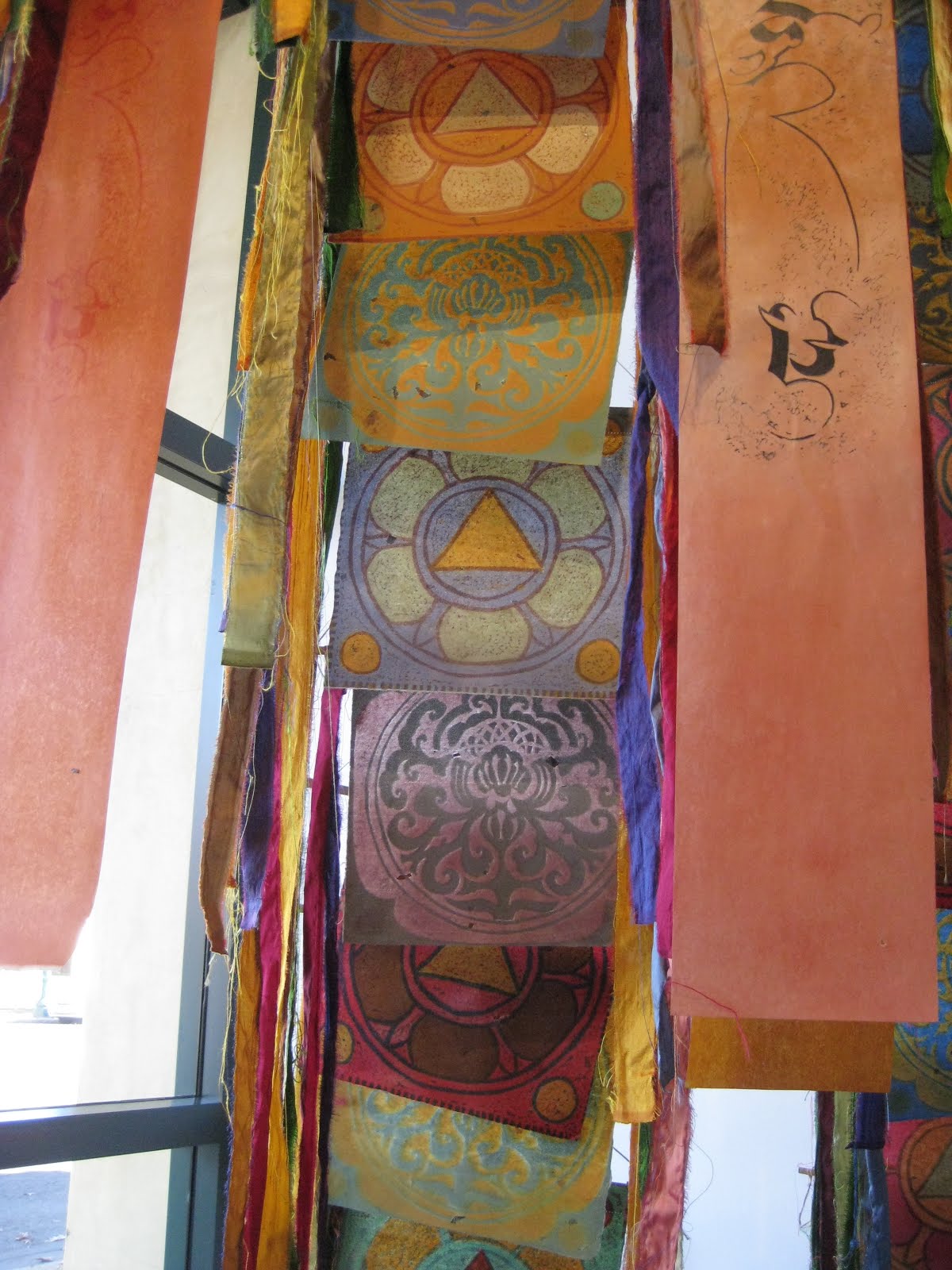
Finally, I got to spend some time with the installation of Tibetan prayer flags and paper in the front of the museum. I forgot to note the information down about the story behind the piece, but nonetheless, it was beautiful.


Sunday, October 28, 2012

Fibershed Papermaking Workshop


This month has been a whirlwind, and I've barely been able to keep up with this blog, as exemplified by the tardiness of this post. Two weeks ago I taught an intensive papermaking workshop for the Fibershed. Specifically, it involved a group of teachers from the Marin County school system who are incorporating sustainable and bio-regional art making activities into their curriculum.

The class covered how to paper from vegetables, invasive plants, and clothing. Here, some students harvest Andean Pampas Grass seed hair.


The class also covered various preparation methods, from hand beating, to blenders, to the beater itself. Many of the teachers really liked the idea of a classroom full of kids expending their energy by hand beating fiber, but to me it sounds like a cacophonous nightmare.


After learning about prep, we moved on to actual sheet forming. I also discussed techniques on preventing water from getting everywhere in a classroom situation. Over the course of the day, I kept making jokes about kids and how they react to various art classroom situations, and how I tend to handle them, which kept the teachers amused. One even commented that it would be very entertaining to watch me handle a group of kids making paper.


It was a great class, and great to share papermaking with a group of enthusiastic people who asked so many good questions, danced around my studio, and kept me on my toes the entire day.


Thursday, October 25, 2012

Studio Photos


I recently taught a papermaking class through the Fibershed in my studio. In preparation, I had asked Robert to organize his tool corner of the studio. Instead, he went above and beyond and organized the entire space for me, winning the Ultimate Husband of All Time Award, I think. Before the workshop, while it was set up in preparation for the class, we shot some photos of the space. Above, you can get a good idea of the size - it's about 900 square feet or so, and the reason we decided to rent this house.

The drying area, for prints and pellon. We had built the drying racks back in Philly, using nylon window screening and cheap stretcher bars bought with a coupon at Jerry's Art-A-Rama.


Organized printing and inking tools:


The glowing portal in the back of this photo is the door to our garden, a space I often use for the very wet part of my projects, as well as cooking fiber:


Of course, now that it's all organized, I can't find anything!

Tuesday, October 23, 2012

Shifting Margins at Red Poppy


Some readers of this blog may not be aware that I am the art instructor for Southern Exposure's partnership with The Beat Within. In this program, I visit the Alameda County Juvenile Hall once a week to teach art and writing workshops.

Recently, some work by my students there was selected for the exhibition, Shifting Margins, curated and organized by OFFSpace. OFFSpace is the brainchild of Kathrine Worel and Emmanuelle Namont Kouznetsov. The exhibition is running in two parts, my students' work is on display at Red Poppy Art House.


Due to the complications and unpredictability that youth in juvenile detention experience, it was decided to exhibit digital reproductions of their artwork, rather than originals. This way, if they were released, sent to a group home, aged out of juvenile detention, or something else, their drawings would not be lost to them.


The work is up till November 10.

Saturday, October 20, 2012

"The Art of Handmade Paper" at the Sonoma Valley Museum of Art


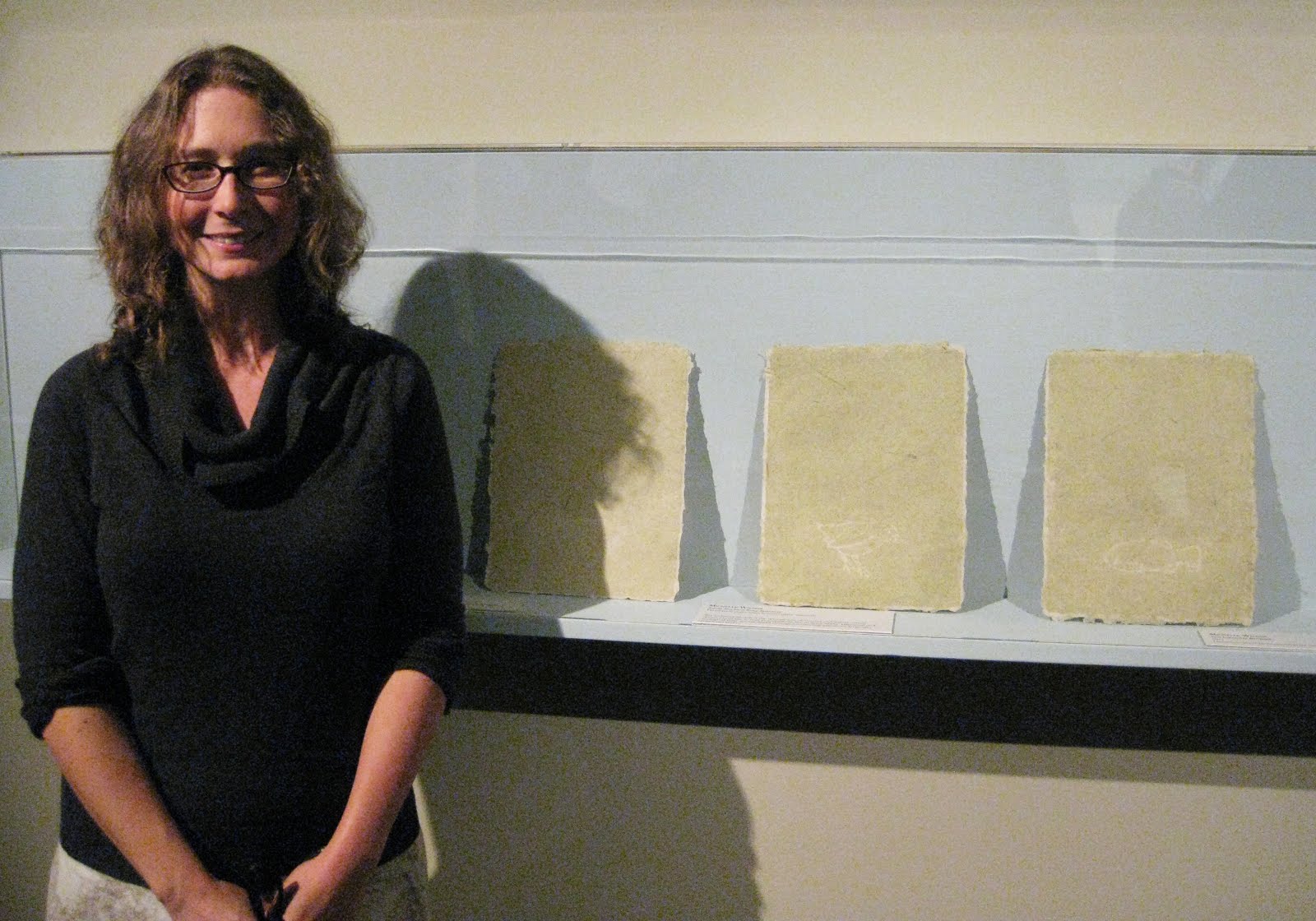
Some of the Population Dynamics series is currently part of the exhibition, The Art of Handmade Paper, at the Sonoma Valley Museum of Art, in Sonoma, CA. The exhibition is up till the end of December, and last Friday I went up for the opening reception.


The show is predominately focused on the history of handmade paper, featuring a few contemporary artists like myself, as well as one of my teachers, Lynn Sures:


Also featuring a tiny little hand-crank beater. This made me think of all the discussions I've had with fellow papermakers about a bicycle-powered beater (which was finally developed by Lee Scott Mcdonald), although several people found pedaling while grinding rag pretty onerous (and could you imagine trying to make something like high-shrinkage? Hours and hours of pedaling!) Anyway, made me wonder if this would be better or worse.


Two other intriguing historic objects included were these fusan bakudan, or Japanese fire balloons. For those unfamiliar with the history, during World War II, these were washi balloons that were used to carry bombs across the Pacific towards the United States, floating along Jet Stream air currents. I gather that most did not make it, but some did. It brings to mind a conversation I had with Mary years ago in which she said something to the affect of," I don't know whether to be horrified or like, YAY PAPER!"


The show is up to December 30, and there is talk with the curator on October 28 at the museum.

On a related note, I was recently interviewed by Discover Paper. Check it out here.